Good Fruit
First and foremost—welcome to the Roundtable! I hope this first entry finds you in good health and with a hopeful mindset.
Before we dive in, I want to share something I didn’t expect would be the topic of my first post on The Timeless Leader. It’s heavier than I had planned, but such is life. Just when we think we have a plan, the world steps in and redirects our path.
That said, I promise this story ends with good news and a valuable lesson. So please hang in there and know that not every entry here will be this personal or this serious.
A couple of weeks ago, I was diagnosed with melanoma. The doctors quickly removed a fairly large section of my arm to ensure they got all the cancerous cells. As you can imagine, it’s been a whirlwind I’ve learned more about skin cancer in the last few weeks than I ever thought I’d need to know.
It started as a small, pink, flaky spot on my arm about the size of a pencil eraser. It didn’t go away. Even the dermatologist initially thought it was just a basal cell carcinoma and wasn’t too concerned. But after a biopsy, it was confirmed: melanoma.
The word cancer alone is enough to stir fear and anxiety and I’m no exception. When they drew the lines to show what would be cut out, I was shocked by how much tissue they needed to remove. The surgeon explained that they had to take not only the obvious cancer but also a margin of healthy cells around it because those nearby cells may have already been affected.
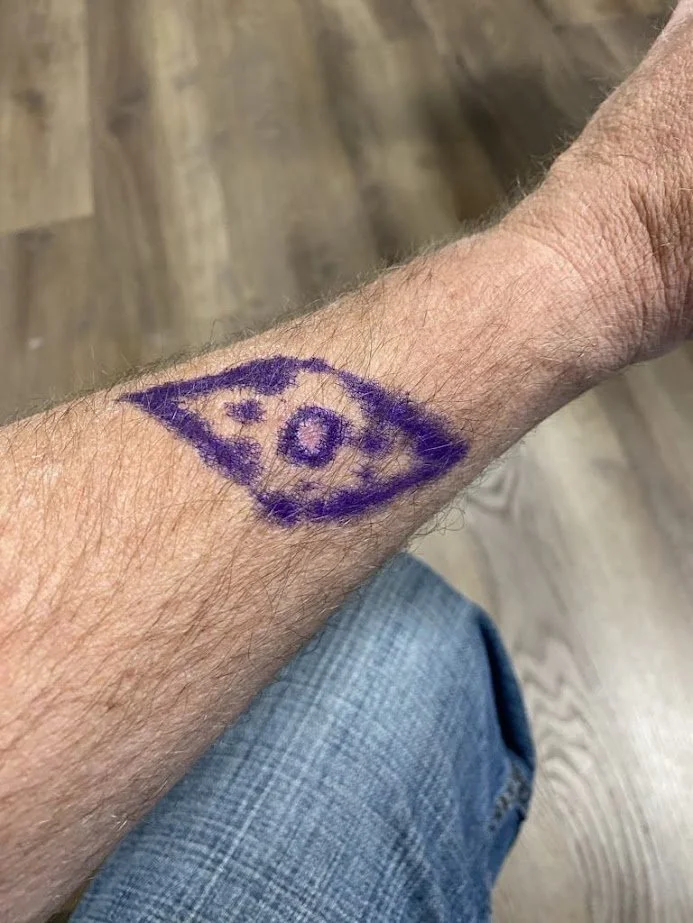
The center area is the melanoma the outline is the area that was removed.
And that got me thinking... about work.
As many of you know, I serve as an operations manager in an electrical contracting company. My role is to identify, develop, implement, and improve our operational systems. And lately, it feels like we’ve been doing the same thing at work as the surgeon did on my arm: cutting out the cancer.
Over the last couple of years, we’ve been redefining our company culture around four core values. As we've clarified our values, the people who didn’t align with them; what I’ll refer to as the “cancer” in our culture began to stand out. Some were removed by our leadership team, but interestingly, many self-selected out on their own.
These individuals had been affecting morale, sowing distrust, and creating uncertainty. And here’s the hard truth: when we removed the most obviously toxic individuals, it wasn’t the end of the issue. Much like the cells surrounding melanoma, the people closest to those bad influences had often been affected too. Some stepped up and thrived. Others revealed the same unhealthy behaviors and had to be removed next.
It’s tempting to think we’ve solved the problem after addressing the most obvious issue but culture, like health, needs ongoing monitoring.
Now, I’m not saying we should immediately cut out everyone associated with a bad apple. But we should pay close attention. Stay connected with your team. Watch for aftershocks. Listen. Sometimes, the real health of your organization is revealed only after someone leaves.
And yes, it’s scary to lose people, especially longtime employees or key personnel. But when you identify someone who is clearly undermining your team, you must act. I fully believe in giving people a chance to change, but that requires:
Honest feedback
Clear examples of misalignment
Defined expectations for growth
And if, after that, they still don’t align with your culture, they need to go. Even if you’re not ready.
Romans 16:17–18 (ESV)
“I appeal to you, brothers, to watch out for those who cause divisions and create obstacles contrary to the doctrine that you have been taught; avoid them. For such persons do not serve our Lord Christ, but their own appetites, and by smooth talk and flattery they deceive the hearts of the naïve.”
Now, you may not work with an all-Christian team, but the principle holds: protect the body. Lead with love, but lead with strength.
Take time this week to reflect on your own team. Identify the areas of cultural cancer. Examine whether the people in those areas can be redirected toward growth or if they need to be removed. Then follow through with intentional care for the ones closest to them, so they don’t quietly inherit the same dysfunction.
Stay grounded. Stay vigilant. And keep leading with vision.