




The Hall Monitor
I’ll admit something.
For much of my life, I was a closet Hall Monitor.
One time my wife and I were downtown on a date. We came to a city street that needed crossing. Without hesitation, she stepped off the curb and started walking straight across — right in the middle of the block!
No crosswalk.
No blinking sign.
Just an empty street.
I stopped.
I stared at her in disbelief… maybe even mild contempt… then glanced down the block toward the clearly marked crosswalk like it was a sacred destination.
I started walking toward the crosswalk.
She stood halfway across the empty street looking at me like I was the crazy one.
I hesitated.
Then — in what felt like a dramatic moral collapse — I committed the grave sin of jaywalking.
It was almost as if I was releasing some inner “bad boy” that had been buried deep within me.
Silly, I know.
But the drive to follow the rules was so ingrained in me that even something as simple — and common — as crossing an empty street mid-block created anxiety.
That’s how deeply I believed in the rules.
I understood them.
I applied them.
I operated inside them.
And if I’m being honest… the rules gave me a sense of control.
If everyone simply followed the guidelines, things would work.
If we all stayed inside the lines, there would be order.
Predictability.
Stability.
Then I discovered something frustrating:
Not everyone follows the rules.
That realization used to anger me. I couldn’t understand it.
Why wouldn’t someone operate within the system that clearly works?
But maturity — and leadership — has a way of humbling you.
The Shift
As I stepped into leadership (often feeling like an imposter along the way), I learned something far more powerful than rule-following:
We get to write the rules.
In our organizations.
In our teams.
In our families.
We are not prisoners to “the way it’s always been done.”
And even more freeing than that?
We can change the rulebook when it no longer produces what it was intended to produce.
But here’s the catch.
If rules are written from ego, fear, or control… they eventually collapse.
If rules are written from frustration… they become weapons.
If rules are written to compensate for insecurity… they suffocate the very people they were meant to guide.
What Governs the Rulebook?
Wisdom has taught me this:
Rules must be governed by values.
Not preferences.
Not moods.
Not reactions.
Values define who we are.
Rules define how we operate.
Rules shouldn’t be a prison.
They should be a guide.
When your rules flow from your values, something powerful happens:
Accountability feels fair.
Expectations feel clear.
Discipline feels consistent.
Change feels purposeful instead of chaotic.
The beauty of leadership is not enforcing someone else’s system.
It is building a system that reflects your identity.
A Question for the Roundtable
Are the rules in your organization governed by clear values…
Or by reaction?
If you had to rewrite your rulebook tomorrow, what values would guide it?
Because here’s the truth:
You are already writing the rules — whether you mean to or not.
The only question is whether they are aligned with who you say you are.
Build Your Rulebook Intentionally
If you’ve never taken the time to clearly define the values that govern your leadership — now is the time.
Because if you don’t define them intentionally, your rules will be written by habit, pressure, or reaction.
And that’s not leadership. That’s drift.
If you’d like help clarifying the values that should guide your rulebook, I created a free resource to walk you through that process.
You can download the Leadership Identity Blueprint here:
👉 Get the Free Leadership Identity Blueprint here.
Define who you are.
Then build the rules from there.

The Comfort of Familiar Ground
Many leaders don’t abandon their core beliefs overnight—they slowly set them aside under pressure.
Deadlines loom, margins tighten, and “this is how we’ve always done it” begins to feel safer than conviction.
This Roundtable explores why leaders drift from what they believe, how comfort replaces courage, and why returning to first principles is essential for leading with integrity in a changing world.
There comes a moment—often quiet, often unnoticed—when a leader begins to drift.
Not away from responsibility.
Not away from effort.
But away from conviction.
We stop asking why and start defending how.
We trade belief for efficiency.
We tell ourselves, “This is how it’s always been done.”
And we convince ourselves that what worked before will always be enough.
After all… it’s gotten us this far.
But “this far” is not the same as where we were meant to go.
When Belief Becomes Inconvenient
Most leaders don’t abandon their core beliefs all at once.
They set them aside—temporarily, they think—when pressure mounts.
Deadlines loom.
Margins tighten.
People resist change.
And suddenly, belief feels expensive.
So we compromise.
Just a little.
Just this once.
We rely on habits instead of principles.
Processes instead of purpose.
Tradition instead of truth.
Not because we stopped believing—but because belief requires courage when the path forward is unclear.
The Quiet Cost of “This Is How We’ve Always Done It”
That phrase is rarely spoken out of arrogance.
More often, it’s spoken out of fear.
Fear of disruption.
Fear of losing control.
Fear of admitting that what once worked may no longer serve the people we’re responsible for.
Yet timeless wisdom tells us something different:
Growth requires renewal.
Leadership requires alignment.
And faith—whether spoken aloud or held quietly—requires trust beyond what is familiar.
What we believe must inform what we build.
Otherwise, we aren’t leading—we’re maintaining.
Returning to the Table
At The Timeless Leader, we believe leadership begins with remembering.
Remembering who you are.
What you stand for.
And why you were entrusted with influence in the first place.
This isn’t about abandoning experience.
It’s about refusing to let experience replace conviction.
It’s about having the courage to return to the table—
to sit with first principles, ancient wisdom, and steady hands—
and ask the harder questions again.
Because the future doesn’t belong to those who cling to what worked.
It belongs to those who are willing to lead with what is true.

Why Most Leadership Advice Fails in the Real World
And what actually works when pressure is real
Leadership advice is everywhere.
Bookshelves are full of it. Podcasts recycle it. LinkedIn celebrates it daily.
And yet—on real jobsites, in real companies, under real pressure—most of it quietly falls apart.
Not because leaders don’t care.
Not because teams don’t want to succeed.
But because much of today’s leadership advice is built for conditions that rarely exist.
The Problem Isn’t Bad Advice
It’s misplaced advice
Most leadership frameworks assume:
Clear authority
Calm environments
Rational decision-making
Willing buy-in
Time to think before acting
But real leadership happens:
In chaos
With incomplete information
Under schedule pressure
Around human emotion
While results are still expected
The gap between leadership theory and leadership reality is where frustration lives.
Why It Breaks Down Under Pressure
When pressure rises, leaders don’t rise to the occasion.
They fall back to who they already are.
That’s why:
New systems get ignored
Processes get blamed
Teams resist change
Leaders revert to micromanagement or silence
It’s not because the framework was wrong.
It’s because the foundation wasn’t there.
The Missing Piece: Identity Before Tactics
Most leadership advice starts with:
What to say
What to do
What system to use
But effective leadership starts with:
Who you are
What you stand for
How you show up under pressure
Without clarity of identity:
Values become slogans
Processes feel imposed
Decisions feel inconsistent
Trust erodes quietly
When identity is unclear, even good tools fail.
What Actually Works in the Real World
Leaders who perform well under pressure share a few traits:
They’re grounded, not reactive
They’re consistent, not perfect
They lead from intent, not control
They use tools to support identity—not replace it
They don’t chase every new tactic.
They operate from a clear internal compass.
That clarity gives teams confidence—even when conditions aren’t ideal.
Timeless Leadership Is Practical, Not Theoretical
Timeless leadership isn’t about old ideas.
It’s about tested ideas.
It shows up as:
Calm in uncertainty
Ownership without ego
Direction without micromanagement
Accountability without fear
This kind of leadership doesn’t depend on:
The latest book
The newest system
Perfect execution
It depends on identity.
Why We Start With Identity
Before processes.
Before tools.
Before checklists.
Leadership works best when it flows from the inside out.
That’s why we begin by helping leaders define:
Their purpose
Their principles
Their personal leadership standard
Because when identity is clear, everything else finally has something solid to stand on.
If you’re building your leadership intentionally—and want a practical foundation before adding tools—you can start with the free Leadership Identity Blueprint.
No hype.
No pressure.
Just clarity.

Steady Hands
After a season of cultural cleanup, the real work begins: rebuilding trust, strengthening the team, and showing up with steady hands.
If you read my first entry, you know the last season of life came with some unexpected challenges. A lot has happened since then, but the lesson that’s been growing in me is worth sharing today; one that feels even clearer with time and distance.
This post is about what happens after the storm.
After the hard conversations.
After the cultural “surgery.”
After the people who weren’t aligned have left.
Because here’s the part no one talks about enough:
Leadership doesn’t end when you remove the problem. Leadership begins in what you build next.
The Quiet Aftershock
When someone who has been undermining your culture exits a team, you feel the shift immediately. There’s relief. There’s clarity. Sometimes even a sense of “finally.”
But then, almost inevitably, there’s quiet.
People look around and ask questions silently:
“Are things actually different now?”
“Can we trust leadership to stay consistent?”
“Is this just another temporary clean-up?”
“Do I still have a place here?”
That uncertainty is normal.
It’s also dangerous if left unaddressed.
A team that has gone through cultural cleanup needs steady hands—leaders who show up the same way every day, with clarity, patience, and presence.
Not loud leadership.
Not heroic leadership.
Just steady leadership.
The Most Underrated Part of Culture Repair
In our company, once we removed the individuals who weren’t aligned with our values, we noticed something surprising: the team did not automatically get healthier.
Removing toxicity doesn’t guarantee health.
It simply removes the barrier to health.
What comes next is the slow, intentional work of rebuilding:
Trust needs time.
Your team will move cautiously until they see enough consistency to relax.Expectations need reinforcement.
Not in a harsh way, but in a way that shows, “This is who we are now.”Relationships need rebuilding.
Some people stayed quiet during the dysfunction. They need space to find their voice again.
This stage isn’t flashy.
It’s not dramatic.
It won’t earn you applause.
But it is the most important phase of culture development.
People Will Rise When They Feel Safe
I’ve noticed something beautiful happening in our own company:
When unhealthy voices left, the right voices started speaking up.
People who once hesitated are now offering ideas.
Employees who felt overshadowed are now stepping forward.
Team members are taking ownership they once avoided.
Why?
Because culture grows where safety lives.
Once a team feels safe—safe to contribute, safe to grow, safe to fail forward—your culture doesn’t just stabilize… it strengthens.
Your Role as the Leader
If you’re navigating a season of cultural rebuilding, here’s your job description for the next few weeks:
1. Be the calm in the room.
People don’t remember every word you say.
They remember how they felt standing next to you.
2. Reinforce values through action, not speeches.
Say less.
Do more.
Let consistency speak louder than announcements.
3. Stay close to the ones who stayed.
Check in with them—not to inspect them, but to reassure them.
4. Celebrate early signs of health.
Small wins matter right now.
Let people feel the momentum returning.
5. Speak hope into the future.
Let your team know where you’re going and why they matter in that journey.
A Verse for the Builders
“Encourage the exhausted, and strengthen the weak.”
—Isaiah 35:3
Leadership, especially after cultural cleanup, is an act of strengthening.
Not forcing.
Not controlling.
Strengthening.
You’re helping people rise again.
You’re showing them that the old patterns are gone for good.
You’re giving them something solid to stand on.
Rebuilding Isn’t Quick… But It’s Worth It
If you’re in the quiet season after removing a cultural cancer, take heart.
This is the part where the good fruit starts to grow.
Stay steady.
Stay intentional.
And keep showing up with the kind of leadership that makes your team say,
“This feels different now—and I want to be part of it.”
Until next time — stay grounded, stay consistent, and keep leading with vision.

Good Fruit
A personal leadership lesson drawn from a melanoma diagnosis exploring how identifying and removing toxic influences can heal both the body and an organization. Learn how to recognize the “bad apples” on your team, protect your culture, and foster long-term growth with values-driven leadership.
First and foremost—welcome to the Roundtable! I hope this first entry finds you in good health and with a hopeful mindset.
Before we dive in, I want to share something I didn’t expect would be the topic of my first post on The Timeless Leader. It’s heavier than I had planned, but such is life. Just when we think we have a plan, the world steps in and redirects our path.
That said, I promise this story ends with good news and a valuable lesson. So please hang in there and know that not every entry here will be this personal or this serious.
A couple of weeks ago, I was diagnosed with melanoma. The doctors quickly removed a fairly large section of my arm to ensure they got all the cancerous cells. As you can imagine, it’s been a whirlwind I’ve learned more about skin cancer in the last few weeks than I ever thought I’d need to know.
It started as a small, pink, flaky spot on my arm about the size of a pencil eraser. It didn’t go away. Even the dermatologist initially thought it was just a basal cell carcinoma and wasn’t too concerned. But after a biopsy, it was confirmed: melanoma.
The word cancer alone is enough to stir fear and anxiety and I’m no exception. When they drew the lines to show what would be cut out, I was shocked by how much tissue they needed to remove. The surgeon explained that they had to take not only the obvious cancer but also a margin of healthy cells around it because those nearby cells may have already been affected.
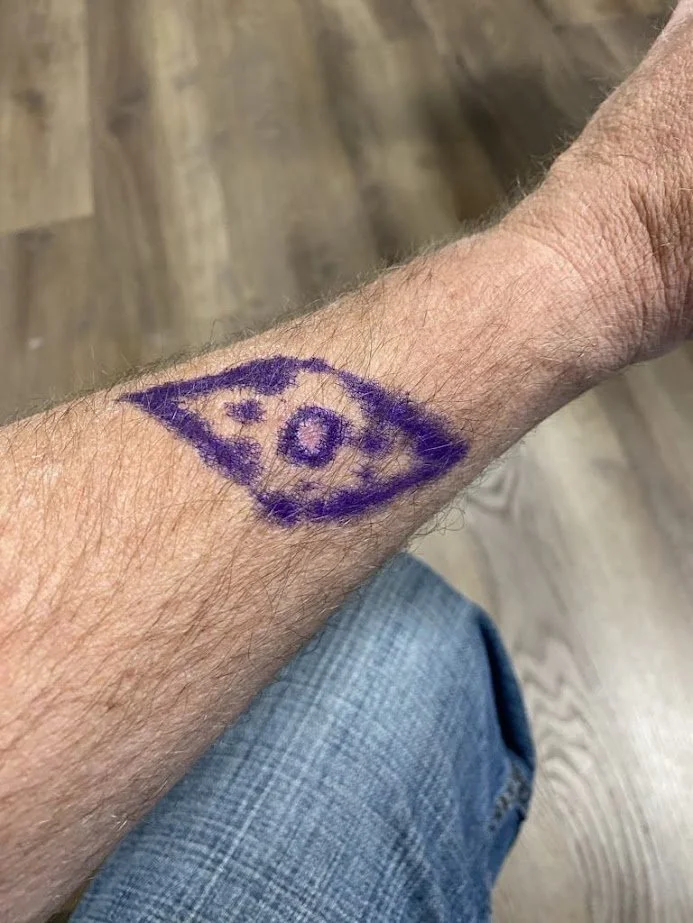
The center area is the melanoma the outline is the area that was removed.
And that got me thinking... about work.
As many of you know, I serve as an operations manager in an electrical contracting company. My role is to identify, develop, implement, and improve our operational systems. And lately, it feels like we’ve been doing the same thing at work as the surgeon did on my arm: cutting out the cancer.
Over the last couple of years, we’ve been redefining our company culture around four core values. As we've clarified our values, the people who didn’t align with them; what I’ll refer to as the “cancer” in our culture began to stand out. Some were removed by our leadership team, but interestingly, many self-selected out on their own.
These individuals had been affecting morale, sowing distrust, and creating uncertainty. And here’s the hard truth: when we removed the most obviously toxic individuals, it wasn’t the end of the issue. Much like the cells surrounding melanoma, the people closest to those bad influences had often been affected too. Some stepped up and thrived. Others revealed the same unhealthy behaviors and had to be removed next.
It’s tempting to think we’ve solved the problem after addressing the most obvious issue but culture, like health, needs ongoing monitoring.
Now, I’m not saying we should immediately cut out everyone associated with a bad apple. But we should pay close attention. Stay connected with your team. Watch for aftershocks. Listen. Sometimes, the real health of your organization is revealed only after someone leaves.
And yes, it’s scary to lose people, especially longtime employees or key personnel. But when you identify someone who is clearly undermining your team, you must act. I fully believe in giving people a chance to change, but that requires:
Honest feedback
Clear examples of misalignment
Defined expectations for growth
And if, after that, they still don’t align with your culture, they need to go. Even if you’re not ready.
Romans 16:17–18 (ESV)
“I appeal to you, brothers, to watch out for those who cause divisions and create obstacles contrary to the doctrine that you have been taught; avoid them. For such persons do not serve our Lord Christ, but their own appetites, and by smooth talk and flattery they deceive the hearts of the naïve.”
Now, you may not work with an all-Christian team, but the principle holds: protect the body. Lead with love, but lead with strength.
Take time this week to reflect on your own team. Identify the areas of cultural cancer. Examine whether the people in those areas can be redirected toward growth or if they need to be removed. Then follow through with intentional care for the ones closest to them, so they don’t quietly inherit the same dysfunction.
Stay grounded. Stay vigilant. And keep leading with vision.